
Smaller, clearer, better: Phonon Multilingual beats Magpie and NeuTTS Nano in French, German, and Spanish
Phonon, our 100M-parameter on-device Text-To-Speech model, produces up to 3.5x fewer word errors than NVIDIA's Magpie TTS in French, German, and Spanish, at 3.6x fewer parameters, and it leads the other on-device voice-cloning models, NeuTTS Nano and the equally compact 100M-parameter Pocket TTS, on both word error rate and speaker similarity in every language we tested. Phonon clones a reference voice across all five languages it supports: English, French, German, Spanish, and Portuguese.
Phonon is built on Continuous Audio Language Models [1] with flow-matching for waveform generation, first announced in April.
Our previous benchmark posts established Phonon as the leader on English. A model that tops the English charts can still mangle French liaison, German compound nouns, or Spanish stress patterns, so this post extends the evaluation to the other four languages: French, German, Spanish, and Portuguese, comparing Phonon against Pocket TTS, Magpie, and NeuTTS Nano wherever a baseline exists.
Phonon at a glance
| Spec | Phonon |
|---|---|
| Parameters | ≈100M |
| Architecture | Continuous Audio Language Model with flow-matching for waveform generation |
| Text frontend | Standard text tokenizer, no per-language phonemizer |
| Languages | English, French, German, Spanish, Portuguese |
| Voice cloning | Yes, from a 10-second reference sample |
| Compute | Single CPU core |
| Memory footprint | ~200 MB |
| Deployment | On-device and offline, no network round trip |
How we evaluate multilingual Text-To-Speech quality
We use the same methodology as our previous Phonon evaluations, applied to one test set per language, and measure two axes.
Word error rate (WER) is computed by transcribing the generated speech back to text and comparing it against the original source with an edit distance from the jiwer package [2]. Lower is better. Speaker similarity is the cosine similarity between speaker embeddings extracted from the reference audio and from the generated speech. Higher is better.
For transcription we use whisper-large-v3 [3], which covers all evaluated languages. We deliberately avoid our own Speech-To-Text model here, so that modeling techniques shared between our TTS and STT models do not bias the results. For speaker similarity we use WavLM large [4]. All numbers were evaluated in July 2026.
Magpie TTS (NVIDIA) and NeuTTS Nano both cover French, German, and Spanish, and we evaluate each on all three. Pocket TTS, a 100M-parameter on-device voice-cloning model, covers all four languages including Portuguese, so it is the one baseline available for our Portuguese evaluation. For English results, including the comparison against Kokoro and NeuTTS Nano, see our previous post.
One structural difference matters when reading the speaker similarity column. Phonon, Pocket TTS, and NeuTTS Nano clone the reference speaker, conditioning on a reference sample for every utterance, so their similarity scores are directly comparable. Magpie synthesizes with a fixed voice and does not clone the reference, so speaker similarity does not apply to it; we mark those cells as such rather than report a misleading score.
French, German, Spanish, and Portuguese: Phonon vs Pocket TTS, Magpie, and NeuTTS Nano
Phonon has the lowest word error rate of any baseline in French, German, and Spanish, and the highest speaker similarity of any voice-cloning baseline, ahead of both Pocket TTS and NeuTTS Nano. The table reports both metrics for each model on the languages it supports.


| Language | Model | WER | Speaker similarity |
|---|---|---|---|
| French | Phonon | 2.18% | 78.98% |
| French | Pocket TTS | 2.87% | 77.65% |
| French | Magpie | 3.48% | Voice cloning not available |
| French | NeuTTS Nano | 4.11% | 64.70% |
| German | Phonon | 0.50% | 73.25% |
| German | Pocket TTS | 1.88% | 71.19% |
| German | Magpie | 1.47% | Voice cloning not available |
| German | NeuTTS Nano | 1.95%* | 61.89% |
| Spanish | Phonon | 0.53% | 81.50% |
| Spanish | Pocket TTS | 1.15% | 80.12% |
| Spanish | Magpie | 1.84% | Voice cloning not available |
| Spanish | NeuTTS Nano | 2.33% | 58.73% |
| Portuguese | Phonon | 1.31% | 85.38% |
| Portuguese | Pocket TTS | 5.88% | 80.25% |
*NeuTTS Nano's raw German WER is 13.73%, inflated by a model hallucination on a single reference voice: NeuTTS Nano leaked that voice's prompt transcript into nearly every clip. Excluding the hallucinating voice, it averages 1.95% over the three remaining voices, which is the figure we report.
In German, Phonon's 0.50% WER is 2.9x lower than Magpie's 1.47%; in Spanish, 0.53% against 1.84%, a 3.5x gap; in French, the hardest set for both models, 2.18% against 3.48%. Magpie does not clone a reference voice, so there is no speaker-similarity comparison against it. NeuTTS Nano does clone, and Phonon leads it in every language on both axes: lower word error rate and higher speaker similarity (in Spanish, 0.53% vs 2.33% WER and 81.50% vs 58.73% similarity).
Pocket TTS is the closest competitor: it also clones a reference voice at the same ~100M parameter budget as Phonon, so it is directly comparable on both axes. Phonon still leads it in every language on both. In German the gap is largest, 0.50% vs 1.88% WER (3.8x lower) at 73.25% vs 71.19% similarity; in Spanish, 0.53% vs 1.15% WER at 81.50% vs 80.12% similarity; and in French, 2.18% vs 2.87% WER at 78.98% vs 77.65% similarity.
In Portuguese, Pocket TTS is the only baseline in our comparison set, and the gap is the widest of any language: Phonon's 1.31% WER is 4.5x lower than Pocket TTS's 5.88%, and its 85.38% speaker similarity, its highest of any language, leads Pocket TTS's 80.25%.
We attribute part of this gap to tokenization. Phonon uses a standard text tokenizer, while Magpie relies on a phonemizer. A phonemizer is a per-language component: its coverage and accuracy vary by language, and its errors propagate directly into synthesis. A text tokenizer transfers across languages with no language-specific frontend, which also makes Phonon more resilient to out-of-distribution text.
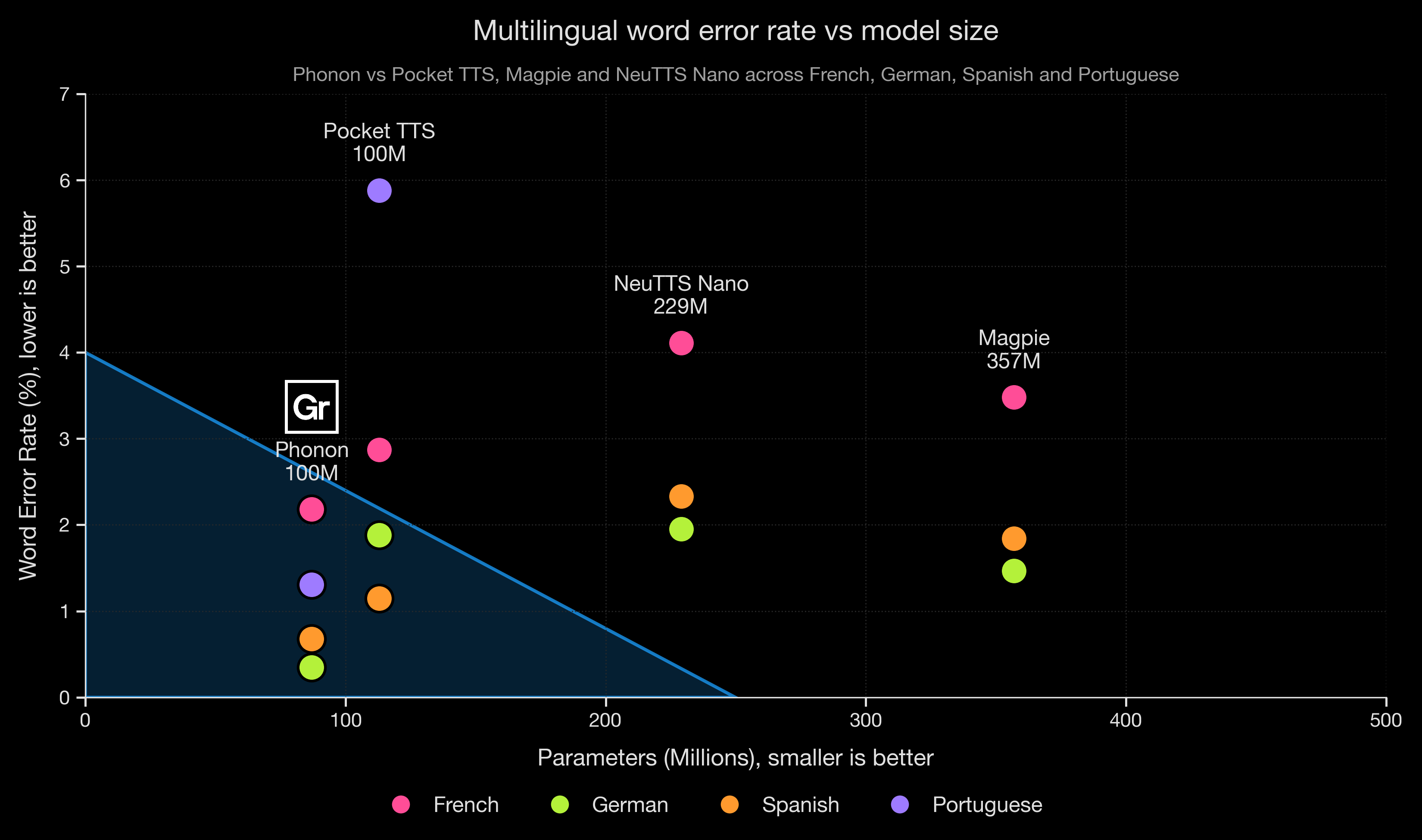
Parameter count vs WER: smaller model, more languages, lower error rate
Parameter count is the constraint that defines the on-device use case. A ~100M model fits comfortably in mobile memory and runs inference on a single CPU core. At 350M and above, memory and compute requirements start to dictate where the model can be deployed at all.
| Model | Weights | Languages evaluated | Average WER |
|---|---|---|---|
| Phonon | ≈100M | FR, DE, ES | 1.07% |
| Pocket TTS | ≈100M | FR, DE, ES | 1.97% |
| Magpie | 357M | FR, DE, ES | 2.26% |
| NeuTTS Nano | 229M | FR, DE, ES | 2.80% |
On the three languages all four models cover, Phonon averages 1.07% WER against Magpie's 2.26%, roughly 2.1x lower, at 3.6x fewer parameters, and against NeuTTS Nano's 2.80% at 2.3x fewer parameters (NeuTTS Nano's German figure excludes the hallucinating voice). Pocket TTS matches Phonon's ~100M parameter budget but averages 1.97% WER, roughly 1.8x higher, so at equal size Phonon still has the lower error rate. Phonon also covers Portuguese (1.31% WER), where it leads Pocket TTS, plus English in our previous post. The takeaway is structural: at or below every competitor's size, Phonon covers more languages with a lower error rate.
Why multilingual on-device TTS matters
On-device Text-To-Speech enables deployments that cloud APIs cannot serve: offline voice agents in vehicles and remote equipment, latency-sensitive products where a network round trip is unacceptable, and privacy-sensitive applications where audio cannot leave the device. None of these constraints stop at English-speaking markets. With a 100M-parameter model we can covers any of the five languages with one inference stack to maintain, and no per-language phonemizer to debug.
Try Phonon
To bring Phonon to your devices, get started at gradium.ai/on-device-tts, or use our contact form. In the meantime, we continue to push for higher quality audio fitting the most compact model size.
Read the earlier posts in this series: Phonon update (May 2026) and Evaluating Phonon.
References
- [1] Kyutai, Continuous Audio Language Models, arXiv:2509.06926: arxiv.org/abs/2509.06926
- [2] jiwer, WER computation
- [3] whisper-large-v3, OpenAI
- [4] WavLM large, Microsoft
Related posts
Phonon update: 1.00% WER on Seed-TTS, smaller than every model we beat
Phonon, our 100M-parameter on-device Text-To-Speech model, reaches 1.00% WER on the Seed-TTS English benchmark, outperforming NeuTTS Air, KaniTTS2, and NeuTTS Nano. With a fixed voice, it drops to 0.83% WER, ahead of Kokoro and Magpie.
Evaluating Phonon: how we made the best TTS model for edge devices
An evaluation of Gradium Phonon, our on-device text-to-speech model. Despite its small size, it significantly outperforms larger models.
Gradium Phonon: On-Device TTS for Consumer Apps, NPCs, and Offline Products
Announcing Gradium Phonon, our new on-device text-to-speech model designed for consumer apps, NPCs, and offline products.
Frequently Asked Questions
Phonon supports five languages: English, French, German, Spanish, and Portuguese. It clones a reference voice across all five from a single 10-second reference sample, using one inference stack with no per-language phonemizer.
On the three languages both models cover, Phonon averages 1.07% word error rate against Magpie's 2.26%, roughly 2.1x lower, at 3.6x fewer parameters (≈100M vs 357M). Per language, Phonon reaches 2.18% WER in French (vs 3.48%), 0.50% in German (vs 1.47%), and 0.53% in Spanish (vs 1.84%). Magpie synthesizes with a fixed voice and does not clone the reference, so there is no speaker-similarity comparison against it.
Phonon leads NeuTTS Nano (229M parameters) in French, German, and Spanish on both axes: lower word error rate and higher speaker similarity. In Spanish, Phonon reaches 0.53% WER and 81.50% speaker similarity against NeuTTS Nano's 2.33% and 58.73%.
Phonon uses a standard text tokenizer, while Magpie relies on a phonemizer. A phonemizer is a per-language component whose coverage and accuracy vary by language, and its errors propagate directly into synthesis. A text tokenizer transfers across languages with no language-specific frontend, which also makes Phonon more resilient to out-of-distribution text.
Word error rate is computed by transcribing the generated speech back to text with whisper-large-v3 and comparing it against the source using edit distance from the jiwer package; lower is better. Speaker similarity is the cosine similarity between speaker embeddings extracted from the reference and generated audio using WavLM large; higher is better. All numbers were evaluated in July 2026.
On-device Text-To-Speech enables deployments cloud APIs cannot serve: offline voice agents in vehicles and remote equipment, latency-sensitive products where a network round trip is unacceptable, and privacy-sensitive applications where audio cannot leave the device. None of these constraints stop at English-speaking markets, and Phonon covers five languages with a single ~100M-parameter model.