

Gradium Extends Funding to $100 Million and Expands to Silicon Valley
The milestone reflects Gradium's rapid rise as a key player in real-time voice AI as it expands its presence to the San Francisco Bay Area to serve developers and companies at the forefront of building the next generation of AI agents.
PARIS & SAN FRANCISCO — July 8, 2026 — Gradium today announced that it extended its funding to $100 million just seven months after its launch. As part of an extension of its seed financing, Gradium is welcoming new investors including NVIDIA. The new funding builds on accelerating momentum for Gradium's voice AI models, and will help accelerate AI research, product development, international expansion, and the establishment of a new office in San Francisco Bay, strengthening its position at the heart of the world's leading AI ecosystem.
Founded in September 2025 by the researchers behind Kyutai, the AI research lab behind pioneering real-time speech systems, Gradium was created to bring years of frontier AI research into production. Founded by Neil Zeghidour, Laurent Mazaré, Olivier Teboul, and Alexandre Défossez, whose work has helped shape the modern field of generative audio, the company develops the foundational infrastructure powering real-time voice AI, enabling developers and enterprises to build natural, low-latency voice experiences with streaming speech-to-text, expressive text-to-speech, and conversational intelligence.
The funding milestone follows a series of major product and research advances across Gradium's voice AI platform. Over the past months, the company has expanded its capabilities across speech generation, speech recognition, translation and developer tooling, reinforcing its position as a leading provider of real-time voice AI infrastructure. Among its latest advances, Gradium introduced a new generation of its flagship real-time Text-to-Speech model, delivering more natural speech and industry-leading pronunciation of complex enterprise content, including acronyms, email addresses, phone numbers and alphanumeric codes.
Gradium has also continued to push the frontier in real-time Speech-to-Text with semantic turn detection, enabling voice agents to understand when a user has finished their thought rather than simply stopped speaking, resulting in faster and more natural conversations. More recently, Gradium launched Gradium Translate, an ultra-low-latency speech-to-speech translation model, alongside Phonon, its on-device text-to-speech model for edge devices, and GradBot, an open-source framework that enables developers to build production-ready voice agents in just a few lines of code. Together, these innovations reinforce Gradium's mission to build the foundational infrastructure powering the next generation of voice-native AI applications.
Gradium has already attracted enterprise customers across customer experience, healthcare, media, AI agents, and consumer applications, generating revenue within weeks of launch. As enterprises and consumers increasingly adopt conversational AI, the company believes voice will become the primary interface between people and intelligent systems.
"Voice AI is reaching an inflection point," said Neil Zeghidour, Co-Founder and CEO of Gradium. "Surpassing $100 million in funding and expanding our investors marks an important milestone for Gradium. It enables us to accelerate our roadmap, expand our Bay Area presence, and bring years of breakthrough research into products used by developers and enterprises around the world."
About Gradium
Gradium builds foundational AI models and infrastructure for voice. Founded in 2025 by Kyutai's founding team, the company provides real-time speech-to-text, text-to-speech, voice generation, and conversational AI technologies that enable developers and enterprises to create natural, responsive voice experiences at scale.
Related posts
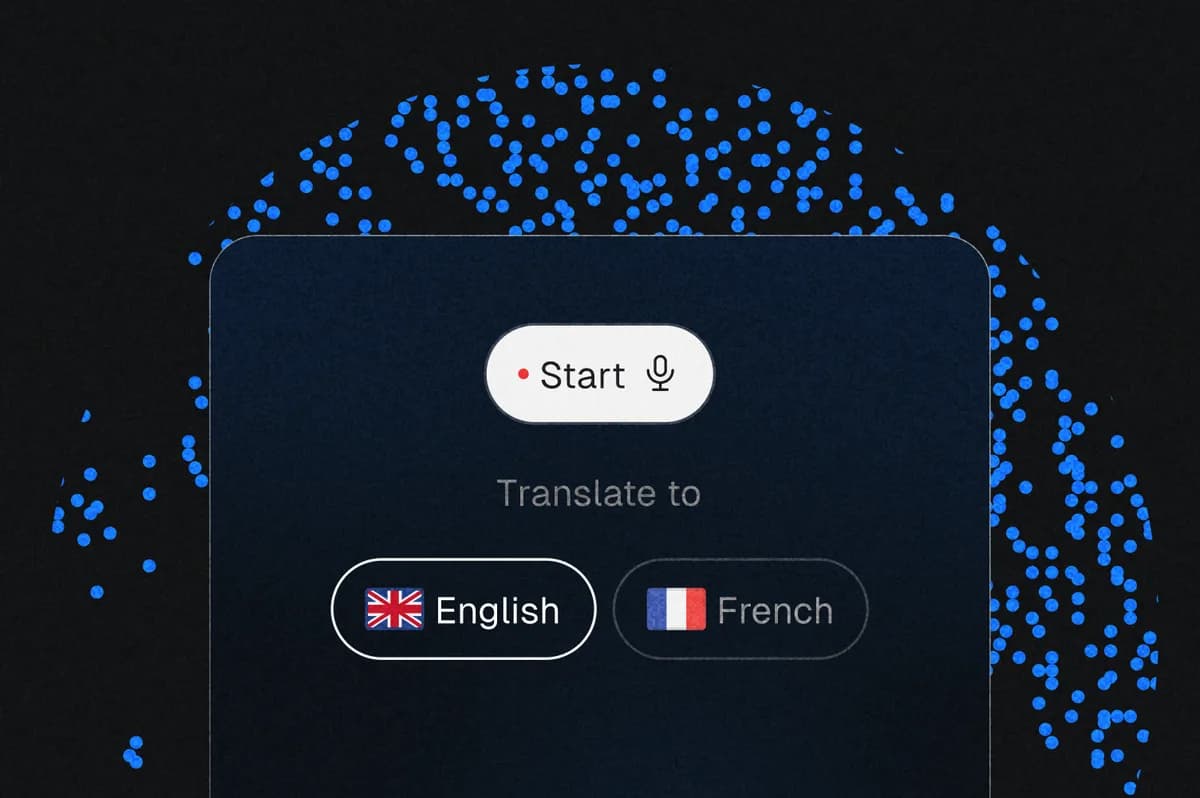
Launching Gradium Translate: the best accuracy-latency tradeoff against gemini-3.5-live-translate and gpt-realtime-translate
Gradium launches stt-translate and s2s-translate: real-time Speech-To-Text and Speech-To-Speech translation across English, French, German, Spanish, and Portuguese, with a better accuracy-latency tradeoff than gpt-realtime-translate and gemini-3.5-live-translate and full control of the output voice, including cloning.

Gradium TTS, upgraded: more accurate Text-To-Speech
Gradium TTS now runs on a new model: more natural prosody and substantially more accurate pronunciation on the cases that break voice agents in production, including spelling, acronyms, emails, phone numbers, and codes. It wins head-to-head against our previous model in all five languages, and leads real-time competitors (Cartesia Sonic 3.5, Inworld TTS 1.5 Max, ElevenLabs Flash v2.5 and Multilingual v2) on the hardest pronunciation cases. Available now as the new default, with custom voices carried over.
Semantic VAD: turn detection that uses meaning, not silence
Acoustic VAD answers "is there a voice right now?" Semantic VAD answers "is the user done talking?" Here's why the distinction decides whether a voice agent cuts users off, how Gradium STT emits multi-horizon turn-completion predictions every 80 ms, and how to tune delay_in_frames, horizon, and flushing for your use case.
Gradbot: Vibe code voice agents in 50 lines of code
Gradbot is our open-source framework for prototyping voice agents in minutes. Built on a Rust orchestration core, it handles turn-taking, interruptions, silence, and async tool calls so you can ship a working voice experience in around 50 lines of code.
Gradium Phonon: On-Device TTS for Consumer Apps, NPCs, and Offline Products
Announcing Gradium Phonon, our new on-device text-to-speech model designed for consumer apps, NPCs, and offline products.
Frequently Asked Questions
Gradium has extended its funding to $100 million, just seven months after launching. The milestone came as an extension of its seed financing, which welcomed new investors including NVIDIA.
As part of the extension of its seed financing, Gradium welcomed new investors including NVIDIA. The funding supports AI research, product development, international expansion, and the establishment of a new office in the San Francisco Bay Area.
Gradium was founded in September 2025 by Neil Zeghidour, Laurent Mazaré, Olivier Teboul, and Alexandre Défossez, the researchers behind Kyutai, the AI research lab known for pioneering real-time speech systems.
Gradium is establishing a new office in the San Francisco Bay Area, strengthening its presence at the heart of the world's leading AI ecosystem and serving developers and companies building the next generation of AI agents.
Gradium builds foundational AI models and infrastructure for voice, including real-time speech-to-text, expressive text-to-speech, speech-to-speech translation (Gradium Translate), an on-device text-to-speech model (Phonon), and the open-source GradBot framework for building voice agents.